Adagio, a tuo agio, il festeggiar d’un bacio,
tbissima lewn ix-xemx, turisti f’art il-ħolm,
arc-en-ciel, que tu es belle!, deux corps qui font une ombre,
si scioglie la mia lingua, e chiudo gli occhi, e taccio…
from Ciao amore ciao
.
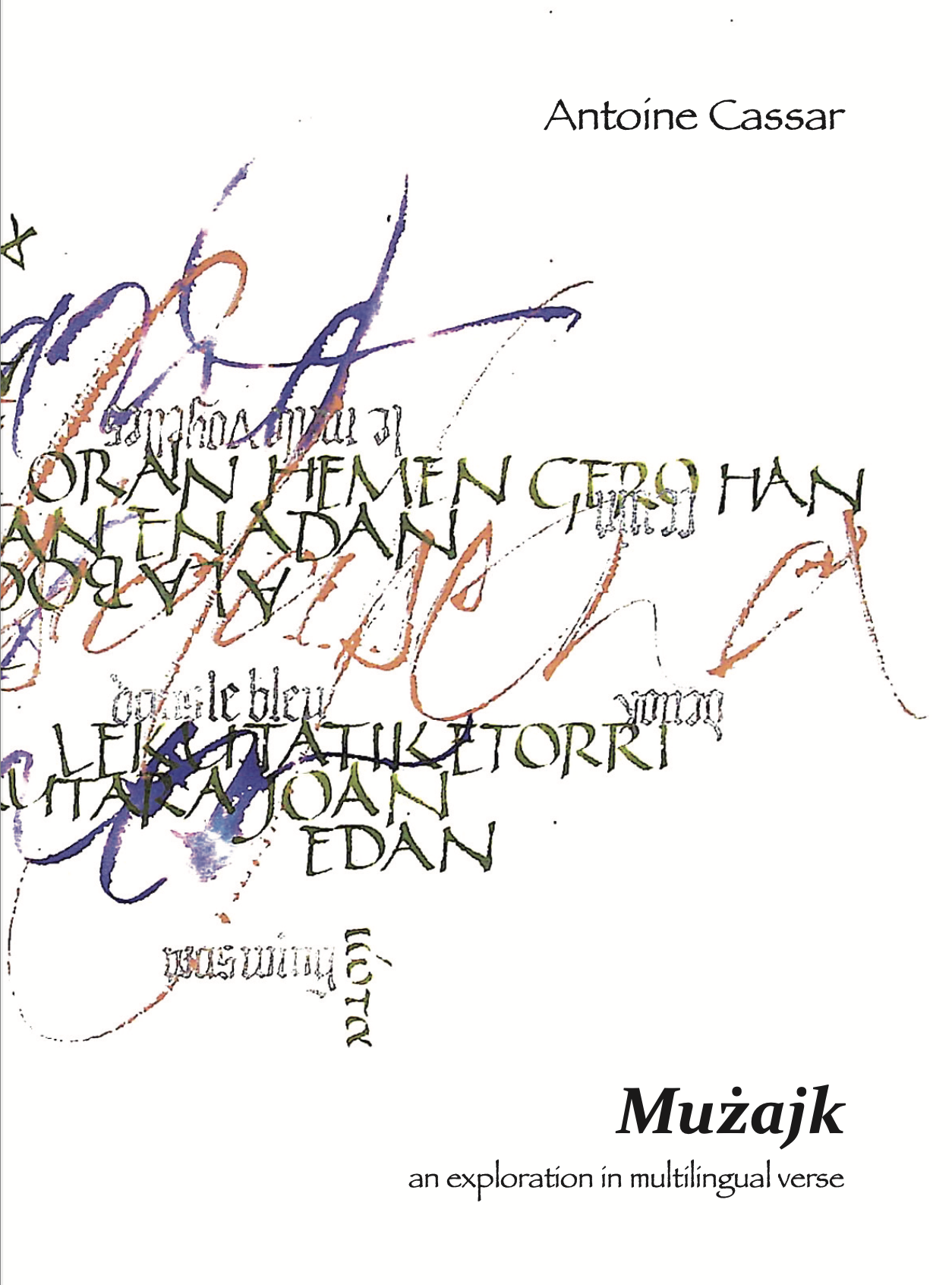
Mużajk (2004-2008) was an exploration in multilingual verse, braiding together the sounds and cadences of different tongues into a fluid rhythm and a coherent stream of thought.
The fifteen mosaics selected for this book show the swift evolution of an at once serious and ludic experiment into a genuine medium for personal, philosophical and planetary expression, allowing the nomadic I to comfortably listen and respond to voices in different tongues without the pressing need to translate all thoughts, ideas and emotions into a single language.
Mużajk was published by Edizzjoni Skarta, on the occasion of two poetry readings in Sannicandro di Bari (as part of an artistic project directed by Italo-Lebanese duo Radiodervish) and in Lecce, Italy. The cover illustration, Gonbidapena, is by international calligrapher Massimo Polello.
Click here for a detailed introduction to the Mużajk poems.
The first phase of the mosaic, focusing on personal and philosophical expression, covered themes such as the pleasure and futility of living, love unrequited or fulfilled, the beauty of the Mediterranean, the desire for simplicity in an ever-increasingly complicated lifestyle, and the at once exhilarating and disorienting feeling of variety itself.
I
C’est la vie
White Knight Syndrome
Bateau ivre
Ciao amore ciao
The second phase of the mosaic was more outward-looking, introducing the concept of the ‘guest’ language sown into the fabric of the five main tongues. The guest language – which is not necessarily legally recognised or widely spoken – is always related to the theme of the individual poem, often a visit to a particular village or city. Self-centred expression begins to give way to meditation on and reaction to the predicaments of particular communities or peoples facing the dangers of rampant capitalism, climate change, or the institutional violation of human rights.
The third phase of the mosaic moved more into the semiotic, with the ‘guest’ language or script being taken as a symbol for a wider, more universal value or ideal. The poems of this phase particularly examine ancient or endangered tongues, and the presence of the first person is replaced almost entirely by the voices of those whose language (and therefore, whose world) is slipping towards extinction.
III
Gonbidapena
 antoine cassar